

Build AI Agents That Solve Real Environmental Problems
ENVI 5200 (undergraduate) / ENVI 6200 (graduate). Auburn University, Spring 2027
No coding background required.
In this course, you don’t just learn about AI and machine learning, you apply it to real environmental problems and build three working AI agents over the semester. You’ll work on projects like digital soil mapping and predicting and mapping kudzu infestation, using the same kinds of AI/ML methods environmental scientists use in practice.
This course is built for environmental science students who want to use AI and ML tools professionally, not for students headed into computer science or statistics.
3
AI Agents You Build
3
Example Class Projects
15
Week Course
0
Coding Experience Required
Example Class Projects
Throughout the semester, you’ll practice these methods on real Alabama environmental problems. Here are three examples of the kind of projects you’ll work through.
1. Create a Digital Soil Map
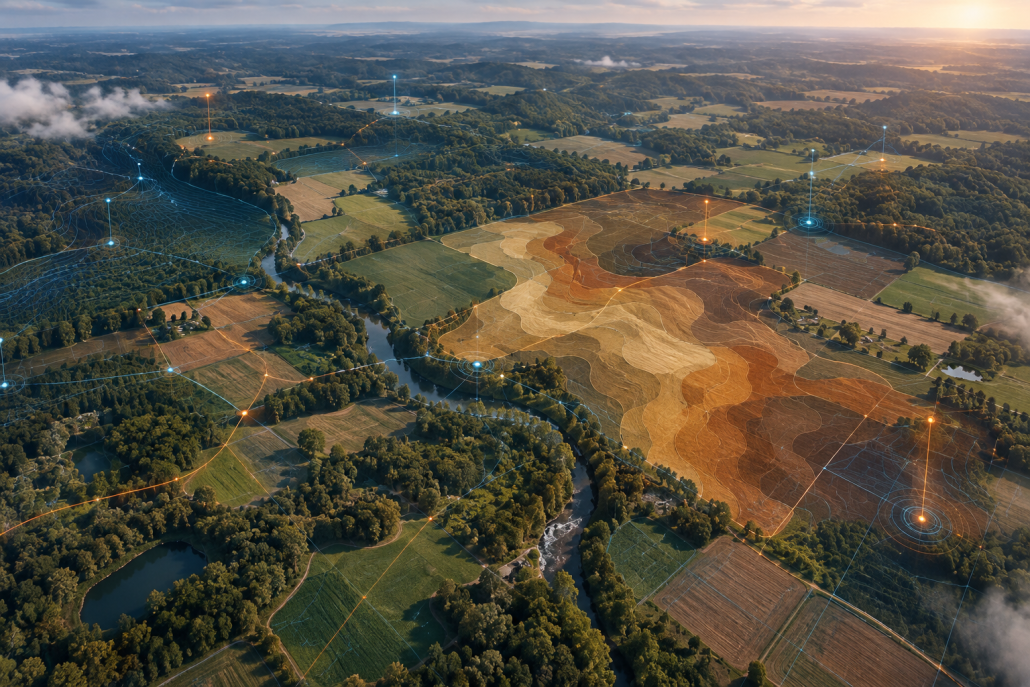
Soil properties change across a landscape, but field sampling every acre isn’t practical. In this project, you’ll combine environmental covariates such as terrain, climate, and remote sensing imagery with known soil sample points to train a machine learning model, then use it to predict soil properties across an entire study area.
The result is a wall-to-wall digital soil map built from a small set of field samples. It’s the same general approach soil scientists use to fill data gaps efficiently, and you’ll get hands-on practice with the full workflow: importing and cleaning data, training a model, and interpreting what it produced.
2. Study Kudzu Infestation
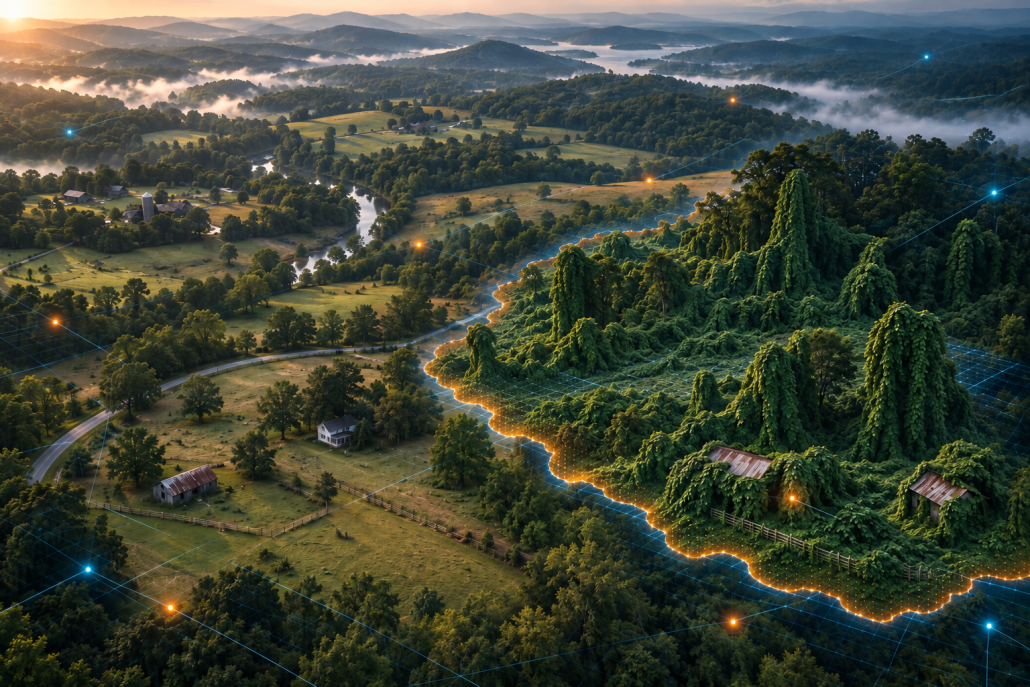
Kudzu is one of the most recognizable invasive plants in the Southeast, but mapping exactly where it has spread is harder than it sounds. Ordinary aerial imagery often can’t tell kudzu apart from other dense vegetation. In this project, you’ll use satellite-derived embeddings, rich, AI-generated representations of the landscape, paired with a machine learning classifier trained on known infested and uninfested locations, to score kudzu likelihood across an entire county.
Projects like this one give you practice scoring an entire county for likely infestation areas, a practical first step toward efficient, targeted field surveys instead of searching blindly.
3. Predict Plant Habitat
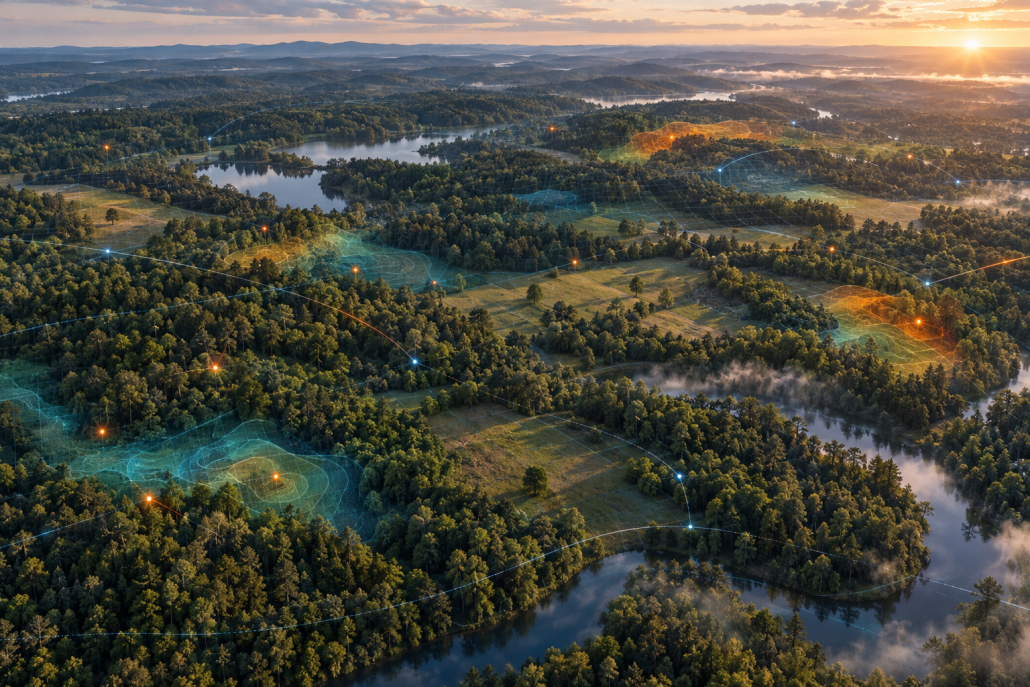
Not every environmental question is about what’s already on the landscape. Some are about where a species could be living but hasn’t been found yet. In this project, you’ll model potential habitat for Apios priceana, a rare native legume, using species distribution modeling (MaxEnt), one of the most widely used approaches in ecology. You’ll relate known occurrence records to environmental variables like climate, soil, terrain, and forest type.
The resulting habitat suitability map highlights areas that share the same environmental conditions as places the species is already known to occur, a useful tool for guiding future field surveys and understanding where a species might be able to persist.
Build Three Working AI Agents
Across the semester, you’ll design, configure, and test three AI agents, each carrying out a real environmental science task:
1. Data Retrieval Agent
Given a location, retrieves and prepares geospatial and environmental data.
2. Anomaly Detection Agent
Synthesizes multiple signals and makes a real judgment call, not just a threshold check.
3. Stakeholder-Report Agent
Turns technical findings into a plain-language write-up for a non-technical audience such as a land manager or policymaker.
By the end of the semester, you’ll chain all three into a single working pipeline.
What Else You’ll Learn
- The AI/ML methods now common in environmental science, including generative AI and foundation models.
- How to evaluate where AI and ML genuinely help and where they fail, including reliability limits.
- The ethical and environmental tradeoffs of using AI and agents in this field.
- How to communicate AI/ML-based findings to non-technical audiences.
Frequently Asked Questions
Do I need to know how to code?
No prior programming or ML experience is assumed. All coding is done in R, in plain scripts, and the course is scoped so a complete beginner can succeed.
Is this a statistics course?
No. The course treats you as a user of AI/ML tools, not someone building or deriving the methods from scratch.
How much work is it?
4 credit hours: two 75-minute lectures per week plus one roughly 2-hour lab, done on your own time, with a weekly instructor drop-in session for lab help.
Who This Course Is For
Students from environmental science and any related field who want hands-on experience with AI and ML tools without becoming a programmer or statistician. That includes students across the College of Agriculture, the College of Forestry, Wildlife, and Environment, and Engineering, along with Geosciences, Biosystems Engineering, and Data Science, no prior coding or ML experience required, undergraduate or graduate.
Interested?
Reach out to Dr. Knappenberger to learn more about ENVI 5200/6200.